
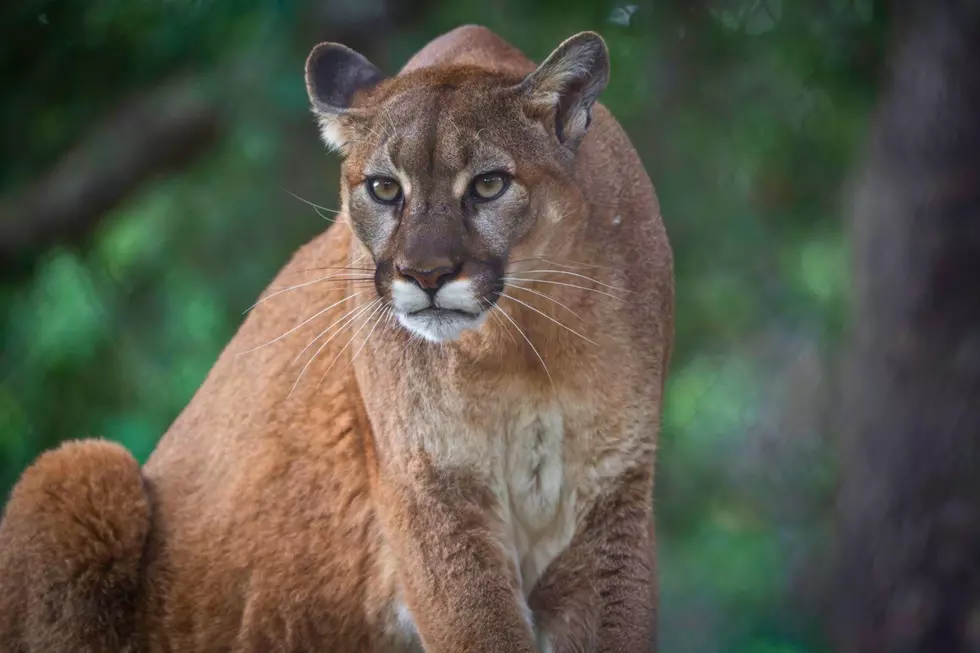
Over the last few years, I've seen an explosion of Facebook posts from Kentuckians claiming they've spotted a mountain lion on their property. And they seemingly bring receipts. Now, before we go any further, make sure you place mental emphasis on the word "seemingly."
I say that because many of these posts feature the same grainy images I have actually seen on other posts from other parts of the country — some where there are ALSO no native mountain lions, and others (like Colorado and Utah) where they are not only indigenous, but plentiful.
It's not hard to gather that those who post these pictures are excited by the prospect that another carnivore (one that can be particularly dangerous, if that needs to be pointed out) is roaming around their neck of the woods. Well, let me show you an example of a Kentucky post from someone who thought they were looking at a lion. (I actually couldn't tell much from this image.)
Kentucky's Mountain Lion History
I'm glad Tammy tagged the Kentucky Department of Fish and Wildlife Resources because that agency will bring its OWN receipts that can effectively shut down any talk about a wild mountain lion population in Kentucky. On its cougar page, it's made very clear that Kentucky has no established breeding population of mountain lions today. In that section, KDFWR references 1974's Mammals of Kentucky, in which researchers Roger W. Barbour and Wayne H. Davis documented no valid records of mountain lions in the Commonwealth after 1899.
But that doesn't mean there haven't been any. In 1997, a female kitten was struck by a vehicle in Floyd County. Its DNA analysis showed South American ancestry, meaning it was captive-bred. More recently, a 125-pound adult male cougar was killed by a conservation officer in Bourbon County. The big cat's DNA was linked to a population in South Dakota's Black Hills, although officials couldn't establish how it ended up in Kentucky.
Why Mountain Lions Disappeared
So why HAVEN'T we had any mountain lions in Kentucky for the last 125-plus years? Fish and Wildlife says mountain lions disappeared following decades of predator eradication campaigns, hunting, and habitat loss.
As Kentucky's forests were cleared for settlements, agriculture, and logging, roads and expanding communities further changed the landscape.
Could Mountain Lions Return to Kentucky?
But why haven't they returned? I think of the mountainous regions of Eastern Kentucky and wonder why they couldn't thrive. The Wildlife Society, however, does not harbor such wonder; a suitable cougar environment would feature forests (check), steep terrain (check, to a certain extent) and relatively low road and human densities (wah, waaaah...sorry, thanks for playing). The nearest known reproducing cougar populations are in states like Nebraska, Wyoming and South Dakota. Although wandering males have been documented in several Midwestern states, none has been confirmed in Kentucky.
As for all those Facebook posts, my cynical guess with regard to some of them is simply that the posters are looking for clicks. Those who genuinely believe they're seeing a mountain lion? I'm going to speculate that they're seeing a bobcat, which Kentucky Fish and Wildlife says now inhabits every county in the state.
Why can't that be good enough?
10 Carnivorous Creatures You Might Encounter in Kentucky
Gallery Credit: Dave Spencer
LOOK: Here are the states where you are most likely to hit an animal
Gallery Credit: Dom DiFurio & Jacob Osborn
